Frontier Computing Sets New Standard With Largest Universe Simulation Yet
December 12, 2025
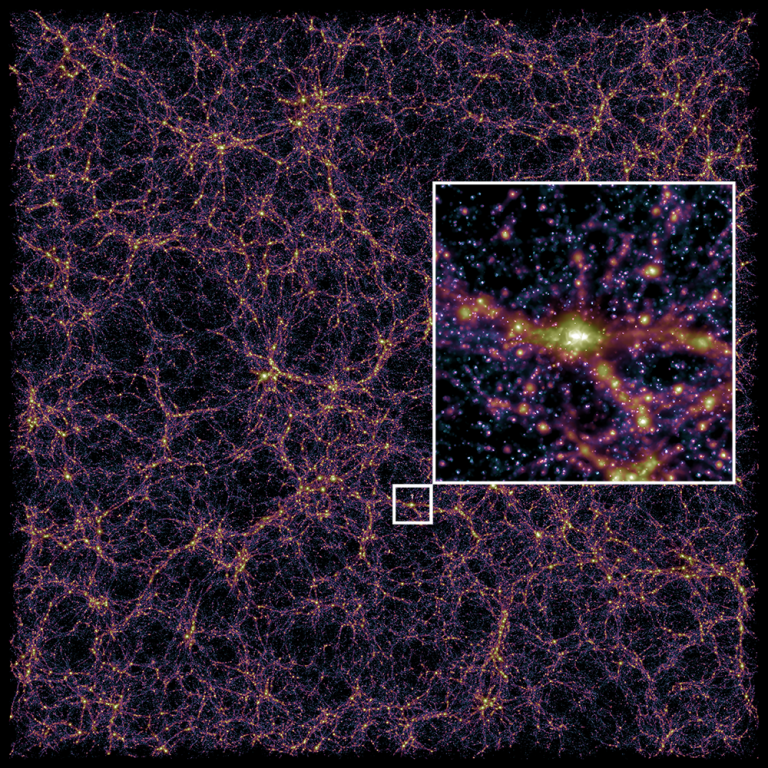
petascale computing models new universe scale.
In a milestone that underscores how high-performance computing has become a cornerstone of scientific discovery, researchers have used the Frontier supercomputer at the U.S. Department of Energy’s Oak Ridge National Laboratory (ORNL) to perform the most ambitious universe simulation ever attempted. The effort, which involved tracking **trillions of particles across a simulated volume spanning some 15 billion light-years, pushes astrophysical modeling into territory previously thought unreachable and strengthens ties between computation and observational cosmology.
Frontier, one of the world’s most powerful exascale machines, is uniquely positioned to tackle such gargantuan problems. With a peak performance measured in exaFLOPS — quintillions of calculations per second — and thousands of interconnected GPU-accelerated nodes, it offers the kind of raw computational firepower needed to model both dark and ordinary matter simultaneously at cosmic scales.
The latest simulation harnessed nearly 9,000 of those nodes, stretching the capabilities of Frontier’s Hardware/Hybrid Accelerated Cosmology Code (HACC) to its limits. HACC was originally developed to adapt cosmological calculations to cutting-edge supercomputers and has been iteratively refined over more than a decade to maximize performance on exascale systems.
Unlike earlier models that focused solely on gravitational interactions, this new run incorporated hydrodynamic physics — simultaneously modeling gas dynamics, star formation, black holes, and other phenomena along with the influence of dark matter. This broader physical realism lets scientists directly compare simulation results to the kinds of data being gathered by today’s leading telescopes and observatories, bridging theory with observation in ways that were not possible before.
“It’s not just about size,” said Bronson Messer, Director of Science at the Oak Ridge Leadership Computing Facility. “Including baryons and other dynamic physics transforms these simulations from abstract approximations into tools we can use to interpret real observations.”
A New Benchmark for Cosmic Modeling
The scale of this simulation — tracking 4 trillion particles — represents roughly a 15-fold improvement over previous state-of-the-art models, capturing interactions across an expanse of space that rivals the observable universe itself. This allowed the project to produce the most detailed digital universe to date, advancing both scientific inquiry and the HPC techniques needed to support it.
These advances didn’t go unnoticed. The project was submitted as a finalist for the prestigious Gordon Bell Prize, often described as the Nobel Prize of high-performance computing, recognizing both the scientific impact and the technical mastery involved in using extreme-scale systems effectively. Winners will be announced at the International Conference for High Performance Computing, Networking, Storage, and Analysis this November.
Why It Matters Beyond Computation
This simulation isn’t just a numbers game. Cosmological models like this form the theoretical underpinnings for interpreting massive datasets from space telescopes such as the Rubin Observatory and the European Space Agency’s Euclid mission. Matching simulated universes against observed galaxy distributions, dark matter clustering, and large-scale structure formation helps scientists refine their understanding of fundamental physics, including the elusive nature of dark energy and dark matter.
By making these simulations richer — and more directly comparable to real data — researchers can test and falsify theoretical models with unprecedented precision. This represents a shift from merely simulating broad trends to probing deep questions about how the universe evolved from the Big Bang to its present large-scale structure.
Facing Toward the Next Frontier
The success of this simulation also highlights the symbiotic relationship between supercomputing and scientific discovery. Frontier’s hardware enables science that wouldn’t be possible otherwise, while the scientific problems themselves drive innovations in software, algorithms, and HPC architectures.
While Frontier is no longer the world’s absolute fastest machine — newer systems have since come online — its role in pushing cosmic simulations to record scale cements its importance in the exascale era.
Researchers expect that the data produced by these simulations will fuel studies, papers, and new questions for years to come — and that future runs may incorporate even more physics, higher resolution, and deeper integration with observational data.
The universe is big, but supercomputers like Frontier are bigger. And with each leap forward, they bring us closer to understanding the cosmic tapestry in which we live.